https://www.cexpet.com/uccellos-battle-of-san-romano-why-war-is-portrayed-like-a-fairy-tale/
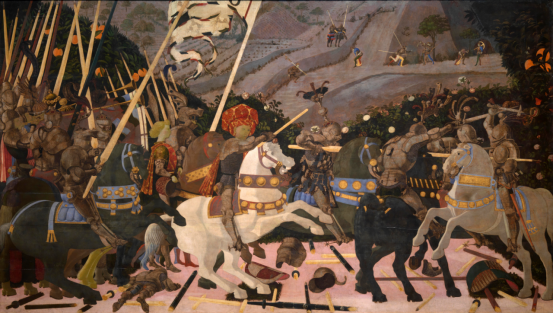
Amidst the Renaissance, Paolo Uccello’s The Battle of San Romano has always evoked a strange illusion. It should be a brutal military conflict, but instead it looks like a meticulously choreographed fairytale puppet show. You might wonder where this incongruity stems from. This article attempts to pierce through the painting’s ornate veil, revealing the magic of perspective, the ingenuity of decorative aesthetics, and the shadow of the Medici family’s power play—and perhaps even empathize with Uccello’s near-mad obsession.
1. What exactly is The Battle of San Romano?
Strictly speaking, it’s not a single painting, but a triptych of tempera panels, created between 1435 and 1460 by the Early Renaissance painter Uccello. The subject is the Battle of San Romano, a minor battle between Florence and Siena in 1432, which Florence won. While it sounds ordinary, the paintings themselves are anything but historical documentaries.
Why? Because it is essentially a “privately commissioned” work of art—a work commissioned by the Medici family to adorn their palace. In other words, it was designed from the outset to be a showpiece: power, wealth, and cultural taste—all packaged for the viewer, not the historian.
Today, the three paintings are housed separately: in the National Gallery in London, the Uffizi Gallery in Florence, and the Louvre in Paris. Their separation seems to heighten their preciousness, and invites viewers to imagine the spectacular spectacle of their complete arrangement.
2. Why is it like a fairy tale? Four visual elements reveal the story
Compared to the war scenes in Goya’s “May 3, 1808” or Picasso’s “Guernica,” Uccello completely banishes us from seeing pain, fear, and bloodshed. His world is detached, dramatic, and imbued with a sense of opulent ritual. Specifically, there are four key reasons for this:
1) A Glittering “Golden Stage.”
He uses extensive gold and silver leaf to depict knightly armor and horse harness. Centuries ago, the entire scene would have been blindingly bright. However, over time, the silver leaf has darkened and the gold has faded, lending the painting an ancient and dreamy atmosphere. Everything seems to shimmer softly, transporting one through time.
2) The puppet-like stiffness of the figures and horses
. Their postures give you the feeling, “Hmm, this isn’t a real battle.” The figures and horses are frozen in time, their every movement meticulously choreographed, as if they were performing a ritual performance rather than a blood-and-fire battle. Strange, isn’t it? This treatment transforms war into something symbolic, even a bit surreal.
3) The orderly, pastoral setting
: Instead of a devastated battlefield, the film features neatly arranged farmland, fences, and fruit trees. The battle takes place in the tranquil countryside, completely undermining the supposed brutality of war. You can almost imagine the soldiers taking a lunch break after battle—the contrast is truly hilarious.
4) Overriding Perspective : Uccello was obsessed with linear perspective. Spears, fallen soldiers, the outlines of fields—all fit neatly within a perspectival grid. This obsession with geometric order almost obscures narrative and emotion, making the painting seem more like a sophisticated mathematical exercise than a literal account of a battlefield.
3. The driving force behind the incident: the Medici family’s personal needs
Without understanding the context of the paintings, the fairytale feel is hard to explain. The paintings were commissioned by Cosimo de’ Medici to decorate the rooms of his private palace. The core purpose is clear:
Show off power and victory : commemorate Florence’s victorious battles and declare the Medici family’s dominance.
Display of wealth and taste : gold leaf and perspective techniques are conspicuous displays of cultural capital.
Personal aesthetics : The owner obviously doesn’t want to see bloody scenes every day. The pictures are gorgeous and orderly, which completely conforms to personal preferences.
In other words, what Uccello painted was not a war report, but a “visual ode” tailor-made for the sponsor, singing all about glory and beauty.
4. The Core of Art History: The Frenzy of Perspective
What truly astonishes this set of paintings is their exploration of perspective. Uccello was one of the earliest artists to delve into perspective during the early Renaissance. It’s said that he once spent an entire night studying perspective, and when his wife urged him to sleep, he exclaimed, “Oh, perspective is so fascinating!” Whether true or not, his obsession with the technique is palpable. In the paintings, every broken spear and every fallen soldier is incorporated into a unified perspective system, guiding the viewer’s gaze and almost prioritizing geometric order over narrative.
5. Conclusion: How to Appreciate This Paradoxical Masterpiece
The charm of “The Battle of San Romano” lies in the tension between content and form. It depicts the irrationality, chaos, and cruelty of war with rationality, order, and gorgeousness. When appreciating it, don’t dwell on “this isn’t the reality of war,” but rather focus on:
The spirit of the Renaissance : How science, rationality, and geometric order permeate artistic creation.
The function of art : how art serves power, embellishes reality and shapes images.
The artist’s obsession : Uccello’s fascination with perspective shaped his unique style.
It is both a dazzling display of perspective, a luxurious ornament of the Medici family, and a gorgeous, austere, and slightly dreamy “fairy tale war.” Only by understanding this can you truly appreciate the unique charm of this contradictory masterpiece.
https://www.cexpet.com/uccellos-battle-of-san-romano-why-war-is-portrayed-like-a-fairy-tale/
