https://www.cexpet.com/masaccios-the-tribute-money-a-comprehensive-analysis-of-narrative-light-and-renaissance-innovation/
Standing before Masaccio’s masterpiece, “The Tribute Money,” you sense a strange tension—no lofty divine aura here, only the perplexities of humanity and the delicate entanglement of authority and obedience. This early Renaissance fresco is not only breathtaking in its scientific perspective, but also employs a “continuous narrative” to tell the complex biblical story of taxation and miracles through a series of faces, each with its own story.
1. What is the Tax Payment Bank?
The Tribute Money is a masterpiece of frescoes created by Masaccio (1401-1428), a pioneer of the Italian Renaissance, for the Brancacci Chapel in Florence around 1425. It is part of a cycle of frescoes on the theme of St. Peter, based on the Gospel of Matthew 17:24-27.
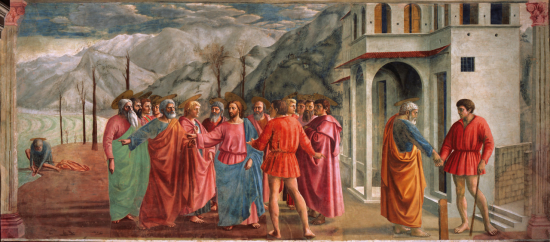
The story seems simple: a tax collector demands the temple tax from Jesus and his disciples. Rather than pay directly, Jesus asks Peter to go fishing in the lake and take a silver coin from the fish’s mouth to pay the tax. It sounds like a minor miracle, but Masaccio’s genius lies in not telling the story across three separate paintings, but in skillfully arranging three scenes from different times and spaces within a single painting, allowing the story to flow naturally, as if time is stretched and compressed, yet distinct and distinct.
2. “Continuous Narrative”: Three Time Periods in One Painting
This is one of the most attractive aspects of The Tribute Money. Masaccio breaks away from the traditional single point in time and cleverly combines three key moments, allowing viewers to understand the story almost at a glance:
Central Scene (Conflict and Instruction) : The tax collector, dressed in short-sleeved Roman clothing, reaches out to Jesus to demand the tax. The disciples’ expressions vary, but Jesus remains calm as he gently gestures Peter to the lake to resolve the situation. Every glance and gesture seems to hint at the next step in the story.
Left scene (miracle action) : Peter bends down and takes the silver coin from the mouth of the fish he just caught. His action is so focused that you can almost hear the sound of water splashing.
Right Scene (Resolution and Delivery) : Peter hands the silver coin to the tax collector, completing this delicate exchange.
Masaccio guides the viewer to flow between three time points through the clever connection between the characters’ postures, gazes and the natural environment. The story unfolds naturally and without abruptness – like a silent movie.
3. Technological Revolution: Perspective, Light and Shadow, and Realism
“Tax Silver” is not only innovative in narrative, but also breaks new ground in technology.
Scientific perspective : Masaccio and Brunelleschi worked to revive classical perspective. In this painting, the architectural lines converge precisely at a vanishing point near Christ’s head, creating a convincing sense of three-dimensional space. The viewer’s eye is naturally drawn to the center of the painting, as if they were there.
Light, Shadow, and Volume : The painting’s lighting originates from the upper right, mimicking the natural light filtering through a chapel window. The folds of clothing are no longer merely decorative; they embody the reality of a flesh-and-blood figure. As shadows fall, the figures seem to possess weight and presence, almost tangible.
4. The Story of Faces: Subtle Capture of Character Emotions
“Every face carries a story”—this saying couldn’t be more apt here. The characters in Masaccio’s paintings are no longer saintly images suspended in the air, but real people rooted in reality.
Christ , calm and authoritative, is the spiritual core of the painting. His composure contrasts sharply with the confusion of his disciples.
Peter : He appears slightly agitated in the central scene, arguing with the tax collector; on the left, he is focused and devout when taking money, and every movement is full of power.
The tax collector has a tough posture and faces away from the audience, which brings a sense of oppression from secular power and also implies the opposition between spiritual authority and secularity.
Disciples : Their expressions are the most vivid – confusion, doubt, whispered discussions, and even secret calculations. Everyone’s emotions are different, as if they are having a low conversation.
From the perspective of an art researcher, the most striking aspect is the treatment of the group portrait. Masaccio, like a director, captures each person’s most authentic reactions at the moment of the outbreak of events. This focus on and portrayal of ordinary human nature is the core of the humanistic spirit of the Renaissance and a powerful farewell to medieval art.
5. Conclusion: Manifesto of the Renaissance
The Tax Money is not just a religious painting, it is a visual “Renaissance Manifesto” –
Art can use science (perspective, anatomy, optics) to depict the world more realistically.
The core of art should be “people”, as well as human emotions, stories and dignity.
Painting narrative can break the constraints of time and has the same freedom as literature.
Despite Masaccio’s untimely death, the seeds he sowed in this painting would later inspire great artists like Leonardo da Vinci and Michelangelo. Standing in Florence’s Brancacci Chapel, facing this six-hundred-year-old masterpiece and feeling the vitality surging from the canvas is an unforgettable experience for every art lover.
https://www.cexpet.com/masaccios-the-tribute-money-a-comprehensive-analysis-of-narrative-light-and-renaissance-innovation/
