https://www.cexpet.com/giottos-kiss-of-judas-an-ultimate-guide-to-early-renaissance-innovation/
When I was a child, I first heard the word “betrayal” in a sermon at Easter. The pastor said that Jesus knew he would be betrayed, but he still chose to look tenderly at the man who handed him over. At that moment, I felt a chill I had never felt before, as if the air in the warm church suddenly became heavy.
Kiss of Judas in visual documentation , that chill came back to me.
At first glance, everything was in turmoil, but he was the only one who was calm.
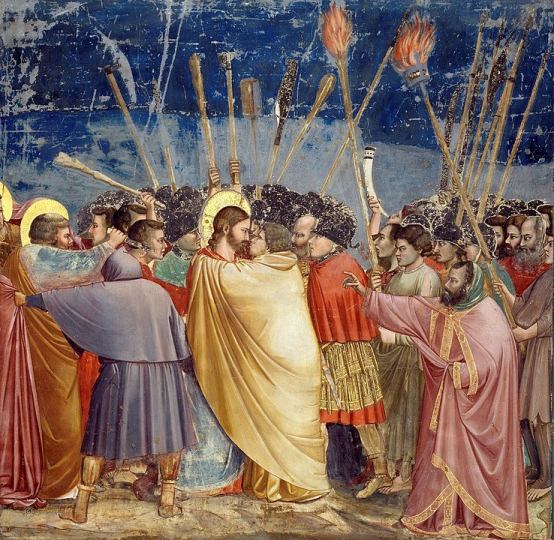
In the center of the painting, Judas in a yellow cape is approaching Jesus, his lips about to touch his cheek. Surrounding him is the night, the raised sticks and spears, and the violence that is about to break out. Surrounded by chaos and tension, Jesus remains motionless, his eyes calm, as if he has already accepted the arrival of this moment. He is looking at Judas, and at each of us who is looking at the painting.
The colors are intense. The yellow cloak almost completely wraps Jesus like a flame about to burn. Blue, gray, and crimson interweave into the texture of the night, creating a sense of foreboding that makes your heart beat faster.
He brought God back from heaven to earth
Giotto di Bondone, a Florentine painter in the late 13th and early 14th centuries, is known as the “father of modern painting.” He did not rely on the golden glory of Byzantium like his teacher Cimabue, nor was he obsessed with perspective and proportion like the later Renaissance masters. What he did was more fundamental and greater – giving the characters in the painting “humanity.”
The Kiss of Judas is the most emotional scene in the cycle of biblical scenes that Giotto was commissioned to paint for the Scrovegni Chapel in Padua around 1305. Rather than depicting a divine and inviolable savior, he depicts Christ as he faces his fate as a human being, about to be betrayed by his friends.
Those silent details hide the thunder and lightning
On the left side of the painting, a disciple is trying to escape, his blue back occupying a corner of the visual center. The halo around him reminds us that he was once chosen. But now, he takes off his cloak and flees naked into the night. This is a short sentence in Mark’s Gospel, but it becomes a vivid moment in Giotto’s pen.
One blew a horn. We could almost hear the brass blasting into the night, turning the holy land into a battlefield.
Peter, sword raised, cuts off a soldier’s ear in the confusion. His rage flashes through the painting like lightning, yet we know that Jesus will rebuke him and “sheath your sword.”
The most central part is Judas’ kiss. His movements are gentle, his lips are close, but his body wrapped in a yellow cloak looks awkward. Yellow, at that time, was the color of betrayal. Judas’ expression is full of hesitation and shadow, as if he himself doesn’t know whether he has crossed the line of no return.
A mural, also the cover of a tragic play
Giotto’s greatness lies not only in what he painted, but also in how he painted. He did not simply reproduce the Bible, but used colors, movements, and sights to tell the story of an expansion of emotions. Every swing of clothing, the direction of every spear, and every micro-expression on the face are part of the narrative.
This is not a frozen picture, but a scene that is speaking and flowing.
In my eyes, it keeps happening
For me, the scariest thing about this painting is that it “never ends”. No matter how many times you look at it, the kiss is always ongoing; the night never ends. Giotto froze a historical node, but also made it eternal – reminding us again and again that the heaviest hurt often comes from the closest people.
Perhaps each of us will experience some kind of ” Kiss of Judas ” in our lives. It doesn’t have to be a betrayal in a religious sense, but a moment when trust is shattered and emotions are betrayed.
Giotto uses this painting to tell us: Even if you are a god, you cannot avoid this kiss. But perhaps, it is this imperfect endurance that makes gods like humans and makes humans closer to gods.
https://www.cexpet.com/giottos-kiss-of-judas-an-ultimate-guide-to-early-renaissance-innovation/
