https://www.cexpet.com/decoding-the-virgin-of-the-rocks-leonardo-da-vincis-masterpiece/
When I was a kid, I often hid in the deepest part of the closet, pulled up a thick blanket, and pretended that I was in a cave. Sometimes when I closed my eyes, I could feel the beams of light pouring down from a crack in the height, casting mottled shadows on my cheeks. I imagined that there was a secret hidden there—not a monster, nor a treasure map, but something more quiet and mysterious.
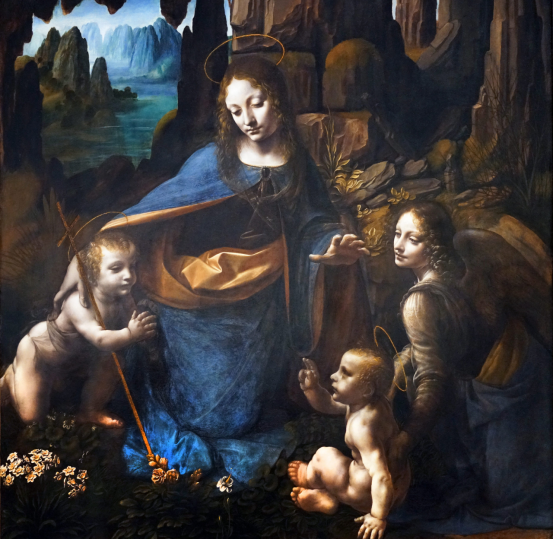
Many years later, I saw Leonardo da Vinci’s ” The Virgin of the Rocks ” in the Louvre, and the familiar feeling suddenly came to my mind. It turned out that the cave I had always imagined was not empty. There was light, gods, and mother inside.
The first gaze: not sublime, but quiet divinity
The picture is very dark, so dark that it almost swallows everything.
The grotto seemed to hide the figures inside, but it was in this darkness that four figures slowly emerged. There was no golden light, no ascending angels, and even no glorious decorations of the temple. Leonardo da Vinci placed the sacred in the cracks of the rocks, allowing the divinity of mankind to grow silently.
At that moment, I was not even sure whether this was a religious painting or not, because it was too quiet, as quiet as a silent prayer.
A Madonna not in a temple: she belongs to nature
This painting was originally made for the Church of San Francesco in Milan, but due to religious and political disputes, it was eventually transferred to another place. The version in the Louvre is believed to be the only one completed by Leonardo da Vinci himself.
There is no glory of the kingship or grand ceremony between the Virgin Mary and the Holy Child, but a very primitive and natural intimacy. Her hand falls on the head of the Holy Child, like a gentle blessing, or like a mother’s subconscious care.
The angel Gabriel beside him did not make exaggerated movements, but just pointed at the little Saint John with a calm and peaceful look. His other hand was around the baby Jesus, and the two children communicated silently through gestures and glances. The connection between these hands and eyes formed an invisible cross in the picture – as if the composition of fate had already been written.
The Virgin Mary did not raise her head, nor did she look directly at the audience. In the painting, she completely belongs to this cave, separated from us by a gap in time.
Rocks, shadows and the indescribable sense of space
The background of the painting is a real cave.
The jagged rock formations, cracks, and wet stone walls are all depicted with extraordinary geological precision – this is not a casual brushstroke, but the result of Leonardo’s work as a scientist and geological observer. He is not painting a holy place, but a real cave, as if the Virgin Mary was actually found and blessed there, not created.
He uses the difference between light and shadow to make the characters emerge from the darkness, rather than “standing in the light”. The blur between the visible and the invisible is the ultimate expression of the “smudge method”. The edges of the characters’ outlines are almost dissolved in the environment. This “non-boundary” expression method is not only a technique, but also a philosophy.
In this painting, the sacred is not a beam of light falling from the sky, but a soft light that diffuses out from the cracks in the rocks, like a breath.
Two versions
Leonardo da Vinci later painted another painting, The Virgin of the Rocks , which is now in the National Gallery in London. This work has been controversial: some people question whether it is entirely from Leonardo da Vinci’s hand, especially the natural depiction of the rock background is criticized as inconsistent with geological logic.
Geologist Pizzo Russo pointed out that the rock in the Louvre version is authentic, while the rock in the London version is hollow. The National Gallery responded that it was a change in style, but skeptics believed that it was not “style” but “a difference in hands.”
We have no way of saying which one is more “authentic”, but for me, the Louvre version retains the feeling of the cave that took my breath away at first – it is a kind of original space, a place where gods live, and a symbol of some kind of “motherhood”.
You can say it’s Maria, or you can say it’s “humanity’s desire for shelter.”
She was quiet, and I was immersed
The Virgin of the Rocks is a painting that cannot be quickly scanned. It has no movement, no climax, it just quietly unfolds, like the beginning of a poem, like the sound of a drop of water falling quietly in a cave.
In Leonardo da Vinci’s paintings, God is no longer high above, but crouches on the ground, sitting with people. Motherhood is no longer abstract and holy, but has a breath of body temperature. It is not an ideal holy image, but a manifestation of divinity with “extreme humanity”.
I often wonder if Leonardo da Vinci was saying: God is not the perfection in the sky, but the ray of light that you have secretly longed for between the cracks in the rocks.
https://www.cexpet.com/decoding-the-virgin-of-the-rocks-leonardo-da-vincis-masterpiece/
