https://www.cexpet.com/the-mathematical-sublime-analyzing-piero-della-francescas-masterpieces/
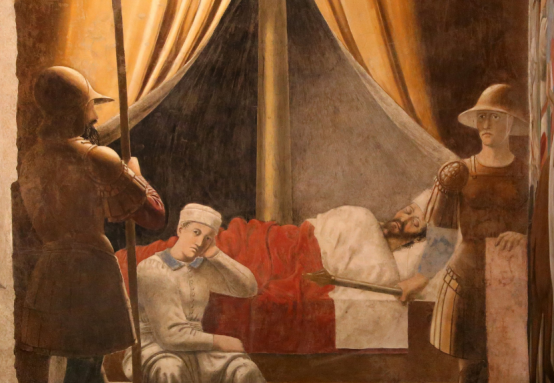
In the Basilica of San Francesco in Arezzo, Italy, quietly resides the epic fresco “The Legend of the True Cross” by Renaissance master Piero della Francesca. One scene in particular is captivating: “The Dream of Constantine.” In it, a mysterious “levitating figure” suddenly bursts into the emperor’s tent, appearing in a shimmering mix of cold moonlight and warm artificial light. It seems to foreshadow a victory that will change history. Some call it “The Dream of Jerusalem,” but I prefer to see it as the most delicate suspension between dream and reality.
1. What is The Dream of Constantine?
“The Dream of Constantine” is a key scene from The Legend of the True Cross, painted by Piero Piero between 1452 and 1466 for the Basilica of San Francesco in Arezzo. It recreates a dream that the Roman Emperor Constantine had on the eve of the Battle of the Milvian Bridge in 312 AD: a divine messenger appears, presents him with a cross, and whispers, “In hoc signo vinces,” (“By this sign you shall triumph”). The next day, Constantine triumphs and converts to Christianity.
If viewed in isolation from the entire series, this painting might seem isolated, but within the grand narrative of “The Legend of the True Cross”, it is the focus of a turning point – the cross gradually moved from the obscurity of history to the center stage of world change.
2. Decoding the Image: The Mystery of Light, Shadow, Perspective, and Suspension
Piero’s genius lies in his ability to depict supernatural dreams with rigorous scientific accuracy – it sounds a bit contradictory, but it is precisely this contradiction that makes the work so fascinating.
Revolutionary light and shadow experiments
Most striking is his treatment of light and shadow. Instead of the dazzling golden light of God, he opted for natural moonlight, which streamed in from the left side of the tent, intersecting with the artificial warm lights held by the soldiers. The moonlight was cold and silent, while the firelight within the tent was warm and rhythmic, creating a subtle dialogue. In the 15th century, such realistic manipulation of light and shadow was almost revolutionary—it imbued the dream with a convincing sense of reality.
Geometry and perspective
Piero was not only a painter but also a mathematician. He constructed the space of the tent with precise perspective, with all vanishing points pointing almost directly towards the sleeping Constantine—the eye is unconsciously drawn there. However, the “levitating figure” breaks this rigorous geometric order—light and suspended, as if stealthily intruding upon our view from another dimension. The tension between rationality and the surreal quietly takes shape in this moment.
3. Speculations about the identity of the “Floating Man”: Angel or Messenger?
This is the biggest mystery of the entire painting and also the most hotly discussed point in academia.
Angelology
Traditional interpretations tend to see him as an angel—with his back to the viewer, he flies in gracefully, holding a small cross. His graceful, otherworldly posture, and suspended state clearly indicate his non-human status, a symbol of divine intervention.
Messenger Theory
Another view is that this is simply an idealized messenger—that Piero deliberately made the figure’s posture transcend reality for the sake of compositional beauty and dreamlike mystery. This interpretation emphasizes narrative function rather than divinity, as if telling us: information is more important than identity.
I personally believe that Piero’s subtlety lies in this deliberate blurring. The messenger, with his back to the viewer and his face blurred, creates a feeling of both reality and illusion—a treatment not due to technical inadequacy but rather a deliberate attempt to create a dreamlike, mysterious quality. You can almost feel the artist gently teasing the viewer’s imagination.
4. How to Appreciate This Renaissance “Dreamscape”
Faced with such a multi-layered work, you might try the following methods:
Positioning and Observation : First, make sure it belongs in the True Cross Legend. Find a panoramic image online to see where Constantine’s dream fits into the narrative, which will help you feel more involved.
Analysis Technique : Pay attention to the play of light and shadow. How the moonlight illuminates the tent and the armor of the soldiers in the foreground, and how the firelight creates the atmosphere within. Feel how light makes the dream seem so “real.”
Ponder the puzzle : Focus on the “levitating figure,” try to navigate between angelic and messenger theories, and form your own understanding. There’s no single answer, and that’s the joy of conversing with a master.
5. Conclusion: Dreams of Time Travel
The enduring quality of “The Dream of Constantine” lies in its seamless fusion of science and fantasy, rationality and sensibility. Precise perspective and realistic light and shadow set the stage, while a supernatural “levitating figure” gently intrudes, breaking all rules. It reminds us that the greatest art often exists between contradictions—dream and reality, faith and reason, narrative and symbolism. Every time you gaze at it, you feel like you’ve traveled back through centuries, participating in the rebirth of an ancient dream.
https://www.cexpet.com/the-mathematical-sublime-analyzing-piero-della-francescas-masterpieces/
