https://www.cexpet.com/the-masterpieces-of-raphael-an-in-depth-analysis-of-the-school-of-athens-and-the-sistine-madonna/
Have you ever had such a moment? Standing between rows of bookshelves, touching the heavy spines with your fingers, a thought suddenly popped up – what were these thoughts that once burned the human spirit like in the beginning? How did that light burst out from one person’s brain and spread to another? I saw this kind of light on a wall in the Vatican one afternoon.
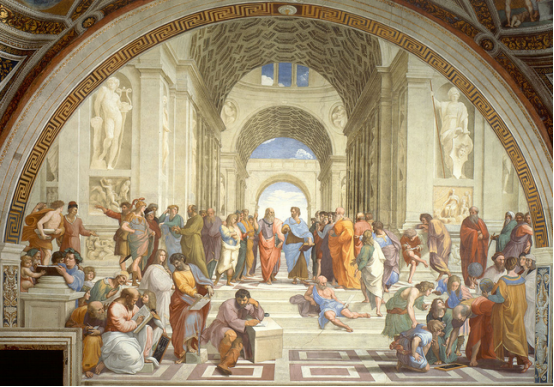
At that moment, I stood in front of School of Athens . The sun was quietly falling through the high windows, and tiny dust particles were floating in the air, like some invisible language was slowly flowing. I didn’t expect it to be so big – more than four meters high and nearly eight meters wide. Even without reading the commentary, I could feel that it was a bit “overly serious”.
But you’ll want to stop, maybe even hold your breath.
The first time I saw this painting: an auditory illusion of traveling through time
They are talking, right? Plato raised his hand, as if to emphasize some unreachable universal law. His finger pointed to the sky – the truth is there. Aristotle was not very convinced, and spread his palms firmly, as if to respond: “Don’t forget your feet.” The two stood side by side, but they were like two diverging roads of thought.
Around them, those who were silent or talking had their own rhythms: one lowered his head to think, one raised his head to question, one turned his back to walk away, and some leaned against the pillar to look at others. You will feel that the floor under your feet is not only covered with light and shadow, but also hides a language that we have not learned.
I stood there and felt as if I had become one of the people in the painting.
Raphael’s mission is not just to paint beautifully
In 1509, Pope Julius II asked the 25-year-old Raphael to paint several murals for the newly built library. It was said to be a decoration, but in fact it was more like a “declaration”: the wisdom of the church must be inherited from ancient Greece.
But Raphael’s response was not dogmatic. He did not reject pagans, but invited philosophers, mathematicians, scientists, and poets to “live on the same wall” together. This was not the high-handedness of the church, but a greater wish: to understand the world, we must rely on dialogue, not suppression.
Take a stroll: Clues are hidden in every detail
Architecture and Space
Does that dome look familiar? Does it resemble the later St. Peter’s Basilica? This is the clue Raphael laid in advance. He used symmetrical structures and extended colonnades to guide your eyes to the center of the picture – the core of this intellectual feast, but it is also open, as if welcoming you to sit in for a while.
Stairs and figures
You will find that the characters in the painting are not walking around randomly. They are distributed at different levels, like metaphors for different academic dimensions. Each step is a process of upward thinking. You see Pythagoras writing with his head down, as if he has just discovered a universal formula; Socrates’ mouth seems to have not stopped yet; Epicurus leans to one side, his expression is between seriousness and laziness.
On the right side of the painting, the young man looks at you secretly. He is Raphael himself. He has drawn himself into time and into the conversation.
A dialogue between colors
The colors of this painting are not strong, but very orderly: red and blue, gold and gray, staggered and matched. It is a bit like the main melody and bass in music, which do not steal the show from each other, but together promote the whole symphony.
The colors of the clothes and the characters’ thoughts do not seem to be randomly matched. Aristotle wears a brown-blue robe, which resembles the color of the ground; Plato wears red and purple, which are closer to the sky. They are a juxtaposition of ideas and experiences, and a balance under conflict.
The last thing I thought of was the “future” of this painting.
School of Athens is not a static mural. It is more like a mirror of thought. Every time you look back, you will see a different self.
Plato and Aristotle are still arguing, they won’t stop; the people in the painting who are staring, silent, thinking, and deducing won’t leave either. And we, as viewers, keep entering and exiting the painting, just like constantly entering and exiting thinking itself.
Sometimes I wonder if there really was a soul in the library, it would look like this painting.
Ending: My echo is more than this
When I left the wall, the sun was still shining, and I looked back—not to remember anyone’s name, but to confirm one thing:
What did I hear?
The answer may not be clear, but I know that the voice of “questioning” has never been far away from human beings.
The thoughts are endless and the echoes never cease.
You and I are just on that step, stopping occasionally to listen and think.
https://www.cexpet.com/the-masterpieces-of-raphael-an-in-depth-analysis-of-the-school-of-athens-and-the-sistine-madonna/
