https://www.cexpet.com/decoding-renaissance-masterpieces-divine-art-history/
1. Work Overview: A visually inspiring dinner moment
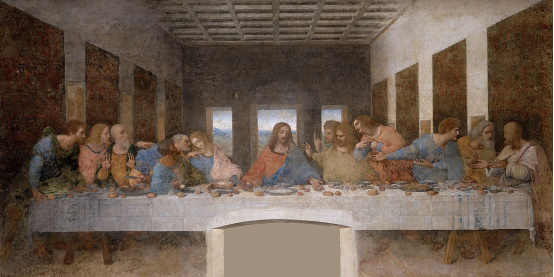
Speaking of ” The Last Supper “, you may first think of the still but turbulent picture. From 1495 to 1498, Leonardo da Vinci painted this dinner party where religion and humanity intertwined on the wall of the refectory of Santa Maria delle Grazie in Milan with his imagination and mathematical precision. This is not a static “eucharist documentary”, but a visual prophecy unfolded by the brush, an attempt to blend the scientific rationality and humanistic emotions of the Renaissance into the wall. It not only allows you to “see”, but also makes you “fall into”.
2. Color Analysis: The Sacred Flow between Light and Color
I can’t overemphasize this: the colors in this painting are really restrained. You won’t see dazzling rich colors in ” The Last Supper “. Instead, the first impression it gives is a soft, slightly melancholy warm tone. The overall main color – warm beige and light gray-blue, combined with the natural light pouring in from the three windows in the background, creates a sacred but not cold sense of space. This use of light is Leonardo da Vinci’s unique “silent narrative”.
The red and blue on Jesus are a delicate balance: red represents humanity, and blue points to divinity. Visually, this color combination firmly nails him to the focus of the picture. The halo spreading outward from his head also makes the whole space seem to slowly “sound” – but the sound is very light, like a whisper in our hearts.
3. Analysis of brushstrokes and composition: the dance of lines, perspective and emotions
Although The Last Supper is not a fresco in the traditional sense, Leonardo chose a mixed technique of tempera and oil painting, which is closer to “painting on dry wall from memory”, making the brushstrokes almost imperceptible. But if you look closely, you will find that the composition is almost paranoid and accurate.
All the orthogonal lines in the picture converge at Jesus’ head, which is both the visual center and the starting point of the emotional vortex. The thirteen people at the table are divided into four groups, three people in each group, and a small theater is happening in each group – it seems that this is not a painting, but a stage play that has just been paused. Three windows bring the blue sky into the scene, leaving a little space for the characters in the painting to escape, which is also like the residual light left by God to mankind.
Look at the movements and gestures. Peter leans forward, holding a knife, but seems to be trying to protect something; Judas sinks into the shadows, holding the silver bag tightly with his left hand, but reaching for the bread with his right hand, echoing Jesus’ hand in the air. Each posture reveals a tension of “about to change in the next second” – but Leonardo da Vinci did not paint “change”, he painted the critical point of “not yet moving”.
4. Thematic expression analysis: the perfect combination of form and content
This scene is not a direct depiction of “dividing the cake” or “betrayal” in your impression, but a “still moment” between the two – the atmosphere where everyone suddenly realizes something is wrong but dares not move immediately, is the moment closest to real human nature.
In religious painting composition techniques, the selection of this “critical time” is quite rare. Leonardo da Vinci was reluctant to depict what had already happened, he preferred to capture “what is about to happen”. The sense of space, the changes in the characters’ expressions, the scattered arrangement of the items on the table, all say one thing: the moment Jesus said “One of you will betray me”, the world stopped.
Jesus sits in the center, his body in a triangular shape, so classic that it seems to have been predetermined. The bread and wine cup in front of him symbolize the Eucharist itself, and his face is a gaze of calmness and compassion. He is not like God, but more like a friend who already knows the end but is still willing to die.
5. Conclusion: A visual prophecy that spans time
More than 500 years later, The Last Supper still attracts countless people, not only because of its exquisite technique, but also because it touches the eternal emotional nodes of human beings: betrayal, trust, and silence despite knowing. It does not attract you with religious miracles, but slowly invades your thoughts through perspective, composition and details.
Some people ask: Why is this painting so shocking? Perhaps the answer is simple – it is too real. Even if you are not interested in “what does Leonardo da Vinci’s The Last Supper represent”, even if you can’t remember all the names of the disciples, you will still see your own shadow on that dining table.
The Last Supper is not only a mural, but also a fateful drama suspended on the wall, hiding the moments that each of us may experience. When we stand in front of it, the light outside the window still falls quietly, as if asking us an unavoidable question: What will you choose?
https://www.cexpet.com/decoding-renaissance-masterpieces-divine-art-history/
