https://www.cexpet.com/botticellis-the-birth-of-venus-an-ultimate-guide-to-myth-art-and-interpretation/
She slowly emerged from the sea, standing on a huge shell, like a god at dawn. She was naked but not obscene, pure but not cold. The question is – is this art? Is it a reshaping of myth? Or is it the ultimate fantasy of mankind’s ideal beauty?
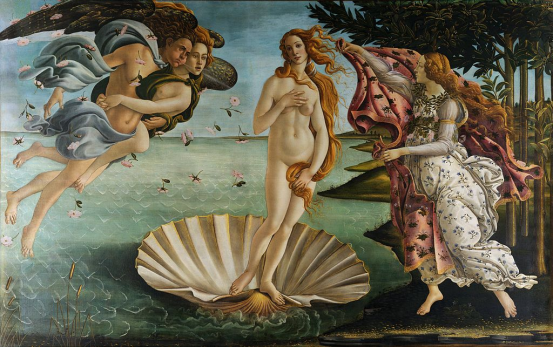
Botticelli’s The Birth of Venus is undoubtedly one of the most memorable images in art history. In the painting, Zephyr, the god of wind, gently embraces the goddess of breeze and brings the newborn Venus to the shore; the goddess of spring opens her flower-decorated robe to welcome her. A poetic scene unfolds before our eyes, and we can’t help but wonder: is this a depiction of ancient mythology, or is it the communication of some deeper spiritual meaning?
A Painter’s Visual Allegory
This work was created in the mid-1480s and is one of the masterpieces of the early Renaissance. It is different from many religious altarpieces, and also different from the multi-metaphorical allegorical works such as “Spring” created by Botticelli at the same time. Botticelli’s ” The Birth of Venus ” is probably one of the works that you can’t forget after seeing it once . And this painting is undoubtedly one of their masterpieces after “loosening the shackles”.
Rather than a mythological painting, it is more like a kind of visual poetry. Zephyr and the goddess of breeze gently push Venus to the shore. The posture with a little sense of stage is not realistic, but not contrived. The goddess of spring stands on the shore, preparing to put a flower robe on the newborn goddess. The whole picture is quiet and full of tension – like the gentle breathing of a girl .
On the canvas, under the faith
The Birth of Venus was painted on canvas rather than on wood, a novel choice for the time. This also means that it was not created for religious purposes, but for the private villas of nobles. The patron was most likely Lorenzo di Pierfrancesco de’ Medici, a nobleman known for his wisdom and cultural taste. The laurel and flowered robe motifs in the painting may be a tribute to “il Magnifico” (Lorenzo the Magnifico).
And Venus. Her body lines are very special – slender, extended, and a little bit inconsistent with the “correctness” of human anatomy. Her standing posture is even a little awkward, with her center of gravity slightly deviated, as if she will be blown away by the wind at any time. But precisely because of this “irrational lightness”, she seems to have come from another world, rather than being forcibly shaped in the world.
Some say that she is not as solid as ancient Greek sculptures. Yes, she is not. She is more like a figure in an ivory carving, with rhythm and floating feeling. This is not a coincidence, but Botticelli did it on purpose. In his paintings, those so-called “gods” often have a texture that is about to dissipate – you can’t catch it, but it is there.
For whom is the painting that is not on the altar painted?
Interestingly, The Birth of Venus was not painted for a church. It was painted on canvas (which was not common at the time) not for worship but for appreciation – or, rather, for the spiritual pleasure of some aristocratic soul.
Some scholars speculate that the commissioner was probably a member of the Medici family , Lorenzo di Pierfrancesco, who was famous for his cultural taste. The plants and decorative patterns in the painting may have been a subtle tribute to him. Art at that time was not always high and mighty, it was sometimes the “private myth” of the rich and powerful.
Beneath the appearance of beauty is a projection of the soul?
In the painting, Venus is a symbol of beauty, but not a superficial one. She is often interpreted as the embodiment of “divine love” in Neoplatonism – a channel that guides physical beauty to spiritual sublimation. In that era when people wanted to combine ancient Greek philosophy with Christian thought, this interpretation was not far-fetched.
But don’t read too much into it. Sometimes, she is just a goddess to gaze at, a presence that makes people relax but can’t take their eyes off.
Meaning? Uncertainty is what makes it fascinating
Different people will read different meanings when they see this painting. Is it a revival of mythology? A new definition of the female body? Or a hint of an aesthetic shift? Maybe it’s all of them, maybe it’s none of them.
In other works of Botticelli, such as The Slander, he once again borrowed the figure of Venus. But this time, she represents “truth”. This reveals some clues: Venus seems to be not only a representative of beauty, but also a symbol of something beyond human chaos.
From the Uffizi to Lady Gaga: The Rebirth of Venus
The Birth of Venus is perhaps the earliest painting of the Renaissance to enter “popular culture.” From the classic water-emergence scene in James Bond’s Dr. No, to Andy Warhol’s silkscreens, to Lady Gaga’s Applause music video, each modern re-creation has brought this goddess back from myth to earth.
The image of Venus has become a cultural matrix, constantly “reborn” in different eras. In the digital drawing software Adobe Illustrator, she has even become part of the tool icon – this may be the most interesting cultural projection: art has come from the temple to the software, and from the Medici studio to your and my desktop.
Final question: Who do you see?
Perhaps, we do not need a unified “interpretation” to define Venus. The meaning of this painting does not lie in a fixed mythological structure, but in how it stirs up ripples in our hearts. It can be an allegory of love, or a reshaping of the female image, a concrete representation of sublime beauty, or a visual puzzle of desire and purity.
This painting has never been finished – its final stroke falls on the audience’s gaze.
So, who is Venus in your eyes?
https://www.cexpet.com/botticellis-the-birth-of-venus-an-ultimate-guide-to-myth-art-and-interpretation/
