https://www.cexpet.com/albrecht-durers-1500-self-portrait-the-ultimate-guide-to-the-christ-like-gaze/
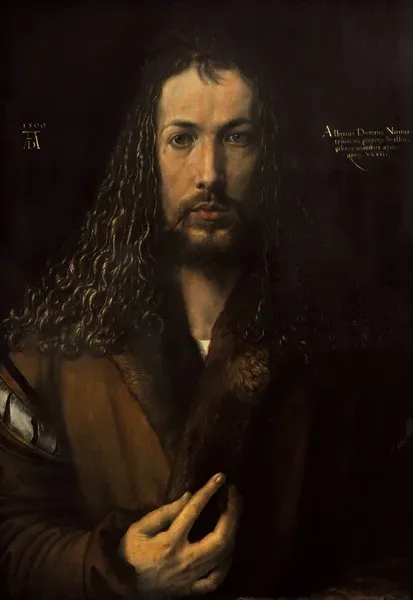
In 1500, 28-year-old Albrecht Dürer created a breathtaking “Self-Portrait.” Did you notice? He doesn’t just look directly at the viewer; he appears in a completely frontal, divine pose—his Christ-like face, gesture, and gaze almost make you feel like you’re facing a deity. This bold composition radically broke with the conventions of portraiture and instantly elevated the artist’s social status to unprecedented heights. This masterpiece, known as the “Northern Eye,” is more than just a self-documentation; it’s an ambitious artistic statement, one that continues to ignite controversy.
1. What is this Self-Portrait?
Painted in 1500, this “Self-Portrait” is Dürer’s fourth and final self-portrait. It is considered the first full-frontal, life-size, freestanding self-portrait in Western art—yes, a full-frontal one. By contrast, portraits of the time were almost universally depicted in a three-quarter profile, a social convention and a sign of modesty. Dürer’s boldness in placing himself front and center was a challenge to tradition, almost raising the artist’s status to a higher level.
Imagine the scene: a young man, staring directly at you with a gaze that carries authority, even a hint of undeniable confidence. You unconsciously hold your breath—as if you were facing some divine being, not just a human.
2. The Face of Christ: An In-Depth Analysis of Composition and Symbolism
Sacred Composition and Gaze
In the painting, Dürer faces the viewer head-on, the symmetrical composition solemn and serene. Those deep, “Northern Eyes” remain unwavering, seemingly piercing the soul. His long, brown hair, parted in the middle and neatly combed, is almost identical to the traditional image of Christ. You feel a strange sense of oppression, yet at the same time, drawn in, unconsciously drawn to its power.
Mystical gestures and symbols
His right hand rests on his chest, fingers slightly curled, as if grasping an invisible object. Some say this mimics the medieval gesture of the Savior holding the Holy Sphere, but I prefer to interpret it as a demonstration of the artist’s identity as a creator. Though he lacks the Holy Sphere, he seems to possess the power of creation, a mysterious and awe-inspiring presence.
An inscription declaring immortality
The inscription in the upper left corner, written in Latin and German, reads: “I, Albrecht Dürer of Nuremberg, painted myself thus, with undying colors, at the age of 28 years.” “Undying colors”—not just a reference to the quality of the paint, but a declaration of the permanence of his work and reputation. You can almost sense the confidence, even a touch of arrogance, of the young man in front of the canvas.
3. Popular Interpretations and Centennial Controversy
There has been a constant debate about Dürer’s intentions, which can be roughly divided into two camps.
The “Narcissistic Genius” Theory
Some have described him as supremely confident, even arrogant, placing himself on a par with Christ. It’s an act of defiance against traditional hierarchies, a supreme expression of Renaissance individualism. You can actually feel this swagger when you look at the image—a bit heart-pounding, a bit awe-inspiring.
Theory of “Devout Believers”
Another interpretation is that Dürer was modestly displaying his divinely endowed talent. He wasn’t comparing himself to God, but rather imitating the role of the divine creator. The artist, creating according to his own inner image, was, in a sense, paying homage to the divine. This perspective imbues the painting with a warmth—it’s more than a show of ostentation, but rather an expression of devotion.
Modern scholars often choose a compromise: Dürer’s actions were both driven by personal ambition and deeply rooted in Christian faith. These two interpretations are not entirely contradictory, but rather reflect the complex tension between humanism and religious faith during the Renaissance.
4. Art History Background: The Self-Awakening of the Renaissance
This painting was not an isolated occurrence. During the Northern Renaissance, the social status of artists was undergoing a fundamental shift. While medieval artists were often anonymous craftsmen, the Renaissance imbued them with a symbol of wisdom and creativity. Dürer, influenced by new perspectives during two trips to Italy, proclaimed in this self-portrait that the artist was not merely a craftsman but a divinely inspired creator. This painting could be seen as a manifesto of the artist’s self-awakening and elevated status, setting a model for generations to come.
5. Conclusion: How to Understand This Timeless Masterpiece
The power of Dürer’s Self-Portrait lies in its ability to be read in multiple ways—as both an expression of ambition and piety, as both a meticulously crafted work of art and a document of thought. You may never fully understand his inner thoughts at the time, but the painting accomplishes its mission: it compels the viewer to recognize the artist’s power, dignity, and divine creativity.
Standing before a painting, you realize that the artist isn’t just the operator of the brush; he’s a way of being in the world. You can almost feel his gaze, a gaze that spans five hundred years—a power that confronts the soul, shocking and compelling you to reflect on yourself.
https://www.cexpet.com/albrecht-durers-1500-self-portrait-the-ultimate-guide-to-the-christ-like-gaze/
